



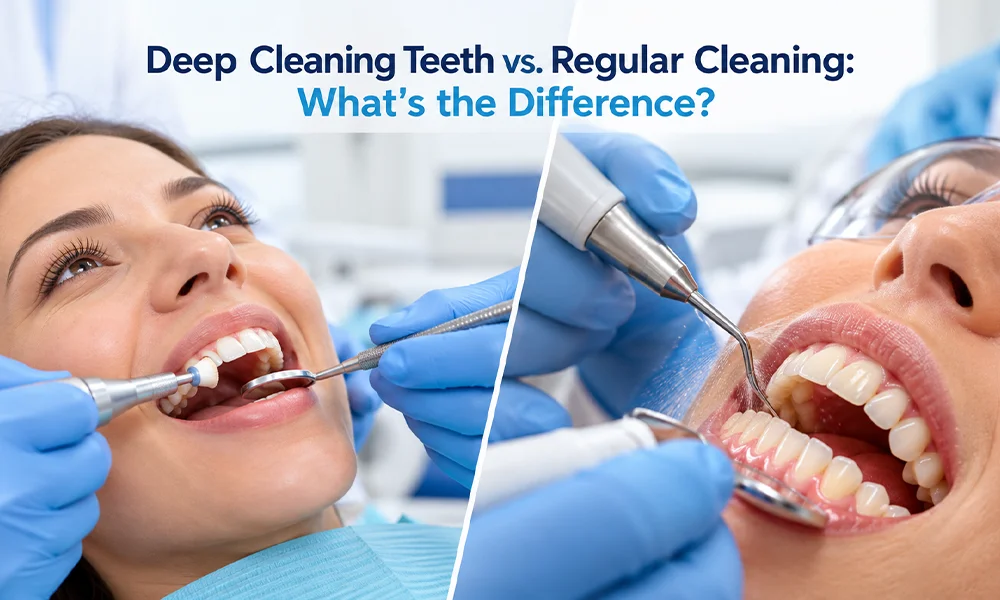
Deep cleaning teeth vs. regular cleaning comes down to the condition of your gums. A regular cleaning is primarily preventive care for generally healthy gums or gingivitis in a few spots. Deep cleaning, clinically known as scaling and root planing, treats gum disease by cleaning below the gumline. Pocket measurements and X-rays help your dentist decide which treatment may be appropriate.
At Nuevo Dental, we provide both routine teeth cleanings and periodontal care based on your individual oral health needs. Our team can assess your gums, check periodontal pocket depths, and review X-rays when needed to help determine whether routine cleaning or treatment such as scaling and root planing is appropriate. If periodontal treatment is recommended, we can also explain what to expect during treatment and the ongoing care needed to maintain your gum health.
What to Know About Regular and Deep Dental Cleanings
A regular cleaning focuses on prevention, while scaling and root planing treats gum disease below the gumline. During a deep cleaning, plaque and tartar are removed down to the bottom of each pocket, then the roots are smoothed so the gums can reattach.
| Feature | Regular cleaning | Deep cleaning (scaling and root planing) |
| Best fit | Generally healthy gums, or gingivitis in a few spots | Pockets too deep for a professional cleaning alone |
| Pocket checks | Our hygienists measure pocket depth during the visit | A follow-up visit re-measures pockets to check healing |
| What comes next | Your dentist can recommend a cleaning schedule based on your oral health and individual needs | Periodontal maintenance at intervals your dentist sets |
How Does A Dentist Decide You Need A Deep Cleaning?
A dentist or hygienist checks your gums and uses a small probe to measure the space around each tooth. In a healthy mouth, these pockets are usually 1 to 3 millimeters deep. Deeper pockets can be a sign of gum disease. X-rays can also show bone loss caused by gum disease.
The ADA explains that a professional cleaning may be enough when gum disease is caught early and has not affected the structures below the gumline. If the pockets are deeper, scaling and root planing may be needed. Your dentist can determine which treatment is appropriate based on the condition of your gums.
Warning signs include red, swollen or tender gums, gums that bleed easily or pull away from the teeth, loose or sensitive teeth, pain when chewing, and bad breath that does not go away. Gum disease can progress before noticeable symptoms appear, so a dental exam is needed to determine whether a deep cleaning is necessary.
Why Deeper Pockets Need More Than A Regular Cleaning
Gum disease is caused by plaque, a sticky film of bacteria. When plaque inflames the gums, they can pull away from the teeth and form pockets. Plaque trapped there is harder to remove with regular brushing and can allow gum disease to progress, potentially leading to bone and tooth loss.
Once plaque hardens into tartar, only a professional cleaning by a dentist or hygienist can remove it.
Gingivitis can be reversed, but periodontitis causes permanent damage and requires treatment to manage it and slow its progression. CDC survey data found that about 4 in 10 U.S. adults ages 30 and older had some level of periodontitis between 2009 and 2014.
What A Deep Cleaning Feels Like, During And After
Scaling and root planing may take more than one visit and may require a local anesthetic.
CLIENT NOTE: Which numbing options do you offer for deep cleanings (local anesthetic, Super Numb rinse, nitrous), and how many areas do you treat per visit?
Afterward, you may have pain for a day or two and tooth sensitivity for up to a week. Your gums may also be swollen, feel tender or bleed. Depending on your condition, your dentist may recommend medication, such as an oral rinse or medicine placed directly into an affected gum pocket. Our periodontal therapy can include Arestin, a prescription antibiotic applied directly into affected gum pockets.
What Happens After A Deep Cleaning
Your dentist may schedule a follow-up visit to assess healing and measure your gum pockets again. If your gum pockets have deepened, additional treatment may be needed.
Ongoing care after treatment is called periodontal maintenance. It follows gum treatment, continues at intervals your dentist sets, and cleans above and below the gumline. Nuevo Dental offers both scaling and root planing and periodontal maintenance cleanings.
CLIENT NOTE: What maintenance schedule do you usually set after scaling and root planing?
Questions To Ask Before You Agree To A Deep Cleaning
These questions can help you understand why a deep cleaning has been recommended and what to expect from treatment:
- Which of my pockets measure deeper than the usual 1 to 3 millimeters?
- Do my X-rays show bone loss?
- Which areas need treatment, and how many visits will it take?
- What will maintenance look like afterward?
- What will my plan cover? Dental benefit plans may have limits or exclusions, so ask your insurer to confirm coverage and any out-of-pocket costs before treatment. We accept most major PPO plans, and our team can help verify your benefits and file claims.
Have Your Gums Checked In North Hollywood
If you have bleeding, swollen or tender gums, a gum examination can help determine whether you have deeper pockets or other signs of gum disease. Our hygienists measure pocket depth during cleanings, and we offer scaling and root planing and periodontal maintenance when additional treatment is needed.
We’re located at 6314 Laurel Canyon Blvd in North Hollywood, serving patients throughout the San Fernando Valley. If you’re concerned about your gum health or have been told you may need a deep cleaning, you can request an appointment to discuss your options with our dental team.
You can also learn more about how long a professional teeth cleaning takes or read about our cosmetic dentistry services if you’re considering treatment beyond routine dental care