



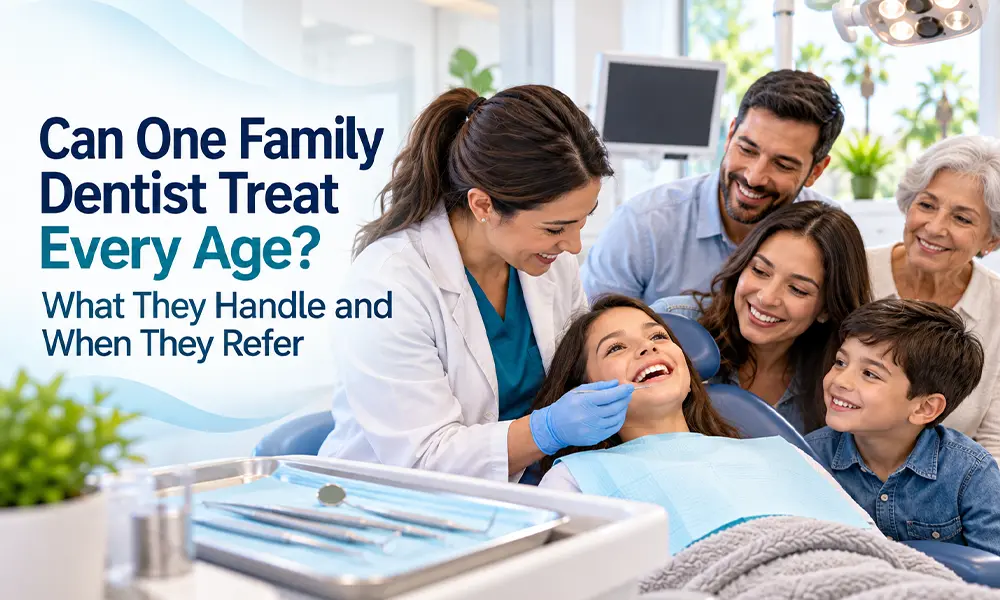
Can one family dentist treat every age in your home, from a toddler to a grandparent? Often, yes. Family dentistry is general dentistry for the whole household, and the ADA says a general dentist can clean teeth, prevent cavities, and diagnose and treat problems in children. That same dentist may refer a child to a pediatric dentist when more specialized care is needed.
Can One Family Dentist Treat Every Age in Your Household?
Often, a single general dentist can provide routine care for the whole family. A general dentist can provide cleanings, cavity prevention, and diagnosis and treatment for patients of different ages. Some conditions may need specialist care.
Family dentistry, however, is not a recognized dental specialty. The ADA’s National Commission lists 12 specialties, including pediatric dentistry, orthodontics, periodontics, and oral and maxillofacial surgery.
Babies and Young Kids: The First Visit Through Sealants
A child’s first dental visit should take place when the first tooth appears, or no later than the first birthday, according to the AAPD and the ADA.
The CDC explains that a sealant is a protective coating painted on the chewing surfaces of the back teeth. Sealants work best when applied soon after the permanent molars come in. The first permanent molars usually come in around age 6 and the second permanent molars around age 12. Applied at these times, sealants can prevent up to 80% of cavities for two years and continue to protect against 50% of cavities for up to four years, according to the CDC.
For more on everyday oral care, read our guide to family preventive care.
Teens: Bite Checks, Sports and Wisdom Teeth
The American Association of Orthodontists recommends a child’s first orthodontic check no later than age 7. A family dentist may suggest an orthodontist for a bad bite or crooked teeth. Parents can also schedule an orthodontic check directly, without waiting for a dentist’s referral.
The ADA recommends mouthguards for organized sports and activities like skateboarding.
Wisdom teeth, also called third molars, usually come through between ages 17 and 21. They don’t always cause problems. Sometimes there isn’t room for them, or they’re in the wrong position to come through the gums. After looking at X-rays, a dentist might advise removing them. Because teeth develop differently in every person, regular checkups help the dental team monitor them and recommend the right treatment.
Adults: Gum Checks, Screenings and Medications
During a routine checkup, the hygienist may check your gums for gum disease. The dentist can also perform an oral cancer screening.
Tell your dentist about your medicines, because dry mouth is a common side effect of many medications, and dry mouth raises the risk of tooth decay. If your dentist identifies gum disease, ask what treatment is appropriate and whether a periodontist’s assessment would help.
Older Adults: Receding Gums and Dentures
The CDC links aging with receding gums. It also advises cleaning dentures daily and seeing a dentist at least once a year, even with dentures. If teeth need replacing, ask your dentist which treatment options may suit you and whether a prosthodontist should be involved.
When Does a Family Dentist Refer You to a Specialist?
| Situation | What the Family Dentist Does | When a Specialist May Come In |
| First visits and routine care for kids | Checkups, cleanings and prevention | A pediatric dentist, if more specialized care is needed |
| Crooked teeth or a bad bite | May identify a bite or alignment concern during an examination | An orthodontist, depending on the bite; first check no later than age 7 |
| Wisdom teeth | Checks their position and development, using X-rays when needed | Ask who would do the removal if it’s advised |
| Gum disease | Checks gums at routine checkups | Ask whether a periodontist’s assessment would help |
According to the ADA, there’s no wrong choice between a general and a pediatric dentist as long as your child sees a dentist regularly, and a pediatric office may suit a child who is more comfortable in a space built for kids. Pediatric dentists complete two to three years of specialty training after dental school and focus on infants and children through the teen years, including kids with special needs.
How Often Should Each Family Member Come In?
There’s no single schedule for everyone. ADA guidance says some people need one or two visits a year and others need more. For children, the AAPD recommends a checkup every six months, adjusted to each child’s oral health. Your dentist should set the right interval for each person.
Make Your Family’s Dental Care Easier in North Hollywood
Before booking, ask our office at Nuevo Dental about the youngest age we see, which cases we refer out, and whether several family members can come in on the same day. We provide gentle dentistry for children, adults, and seniors, and Dr. Mary Yazdan speaks English, French, Spanish, and Persian.
Our office at 6314 Laurel Canyon Blvd in North Hollywood is open Monday to Friday, 9 a.m. to 5 p.m., and on Saturdays when booked ahead. Call (818) 210-0515 or contact the office, or read what to look for in a family practice first.